Welcome to the 2026 Legislative Session. This weekly brief is a UTIA-member benefit. If there is interest in receiving this tracker please refer to becoming a member by clicking here. |
|
| | |
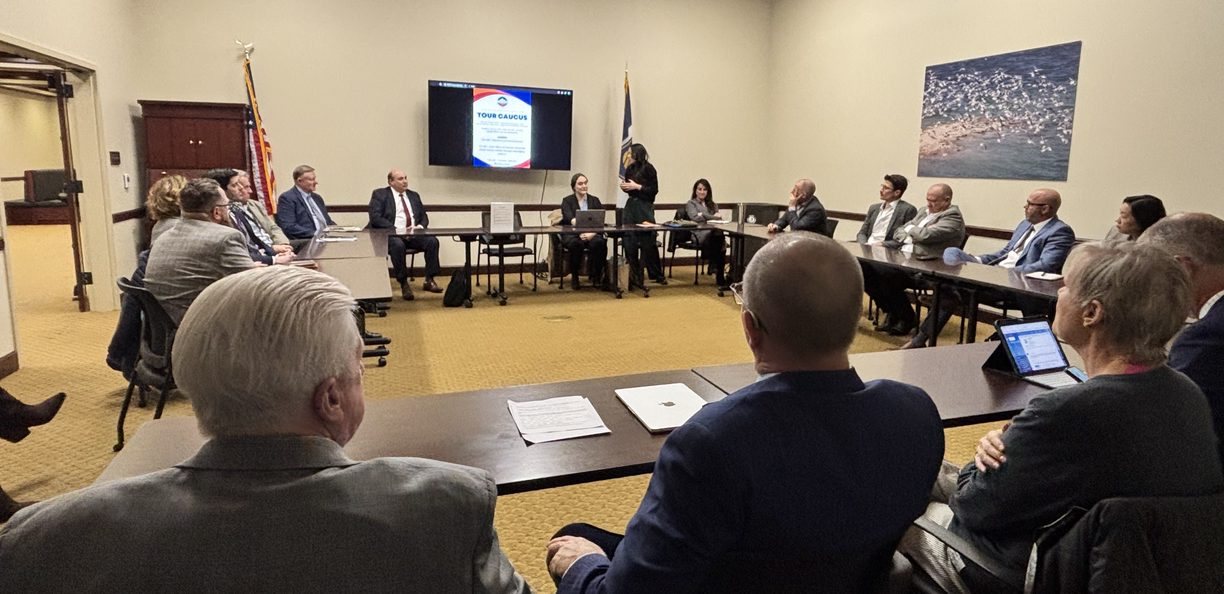
| The Tourism Outdoor Utah Recreation (TOUR) Caucus held a successful first meeting on January 27, featuring a presentation by Natalie Randall, Managing Director of the Utah Office of Tourism, on the newly released Passport to Prosperity annual report, which highlighted “why tourism matters” stories from across the state. The meeting also included an engaging discussion on industry-relevant legislation with over a dozen legislators in attendance. |
|
| Thank you to our TOUR Caucus Chairs - Senator Vickers, Representative Cutler, Senator Stratton, and Representative Brooks - for your leadership on behalf of the tourism and outdoor recreation industries. And a special thank you also goes to all of our industry partners who joined us for a very early morning at the Capitol!
Mark your calendars for the next TOUR Caucus meeting, which will be held on Tuesday, February 17 at 7:00 a.m. in the Seagull Room of the East Senate Building and will focus on outdoor recreation priorities.
|
|
|
| | |
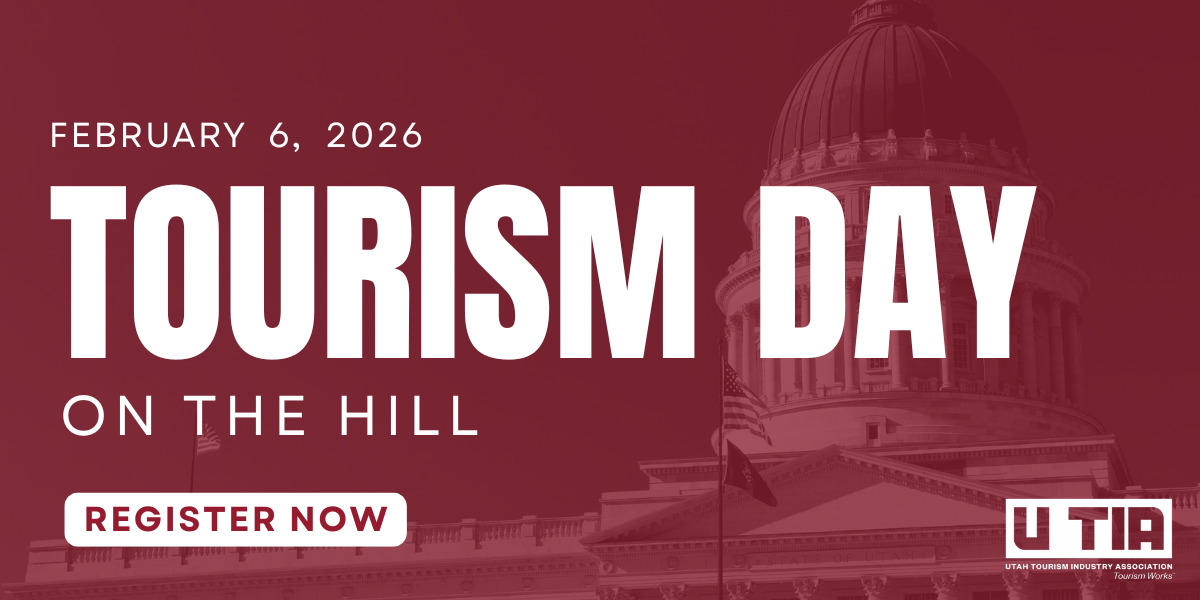
| It’s not too late to register for Tourism Day on the Hill! Join us and fellow industry organizations as we meet at Capitol Hill to discuss 2026 legislative priorities and network with our Utah legislators. |
|
|
| | | ❌ H.B. 161 Property Tax Modifications, Rep. Jill Koford This bill would increase the residential property tax exemption for primary residences from 45% to 60% of fair market value. While framed as homeowner relief in response to rising property tax concerns, the bill does not reduce overall property tax obligations for local governments. Instead, it shifts the tax burden onto commercial and industrial properties (including hotels, restaurants, retail, offices, and manufacturing) as well as second homes.
WHY THIS MATTERS: To offset the expanded exemption for primary residences, businesses would face higher effective property tax rates. According to the Utah Taxpayers Association, commercial properties would see an estimated $309 million statewide property tax increase under the proposed 60% exemption. These impacts would still be felt by Utahns through: Higher prices, fees, or reduced discounts, as increased business operating costs are often passed on to consumers Indirect rent increases on properties that operate under commercial purposes, including short term rentals (primary residential apartments pay at the primary residential rate)
H.B. 161 would only take effect if voters approve the companion constitutional amendment, H.J.R. 7 (below), in the next general election.
❌ H.J.R. 7 Proposal to Amend Utah Constitution - Property Tax Modifications, Rep. Jill Koford The Utah Constitution currently limits the portion of a home’s fair market value that may be exempt from property taxation. As a result, statutory changes such as those proposed in H.B. 161 cannot take effect unless the Constitution is first amended. This would first take 2/3rds of both the House and Senate to pass and then it would be put on the 2026 general election ballot. If voters approve this constitutional amendment in the 2026 general election, H.B. 161 (above) would take effect on January 1, 2027.
📣 TAKE ACTION: Private business owners should contact their House Representative to express concerns about legislation that shifts the property tax burden onto businesses and employers. Placing this burden onto commercial properties could directly impact business operating expenses, pricing, and jobs across Utah.
Resources for reaching out to your legislator:
Legislators need to hear from business owners who will bear the cost of these changes. |
|
| | ❌ HB 231, Restaurant Tax Repeal Amendments, Rep. Norman Thurston This bill removes the ability for a county to impose the restaurant tax on food items and alcoholic beverage items sold at restaurants and prepared foods sold at convenience stores, gas stations, and grocery stores.
Instead, it provides counties with the ability to impose a smaller sales tax amount on all taxable transactions, other than food and food ingredients, at a unique rate per county that will generate the equivalent amount previously generated by the restaurant tax.
WHY THIS MATTERS: The tourism industry opposes HB 231, Restaurant Tax Repeal Amendments. The restaurant tax, which generated over $89 million in 2024, is part of a broader suite of tourism-related taxes authorized under the Tourism, Recreation, Cultural, Convention, and Airports Facilities (TRCCA) Tax Act. These revenues provide a dedicated funding source to county governments for tourism promotion and to develop, operate, and maintain critical community infrastructure. Including airports, convention centers, cultural venues, recreation assets, and other tourist facilities. These assets are shared by visitors and residents alike and contribute to local quality of life and economic vitality.
Part of UTIA’s opposition is that the additional sales tax would further increase the total tax stack on a hotel bill. With recent TRT increases, many of our communities already fall on the higher end of their competitive set for overall hotel check out rate.
The Utah Legislature has long directed that visitors should help offset the incremental costs and services generated by travel, rather than placing that burden solely on local residents. The restaurant tax remains a clear and effective way to accomplish this goal, as dining is an integral and unavoidable component of the visitor experience.
📣 TAKE ACTION: Over the past week, we have found a general lack of awareness regarding this bill. Please share the information provided with local groups that have a vested interest in the TRCCA, including private businesses, chamber organizations, and arts & culture groups to help ensure broader awareness.
Tourism industry stakeholders are encouraged to contact their House Representative to respectfully share their opposition for HB 231.
Industry Talking Points: Identify the community assets, infrastructure, and/or programs in your community that are funded through the TRCCA and include them in your message. Express concerns about shifting a luxury tax into a general sales tax paid by Utah residents. Ask for their support in maintaining the restaurant tax as it currently exists in statute by opposing the bill.
Resources for reaching out to your legislator:
|
|
| | SB 108 S1, Online Marketplace Amendments, Sen. Lincoln Fillmore This bill prohibits a municipality or county from regulating an online marketplace.
WHY THIS MATTERS: The first substitute of this bill was adopted by the Senate Business and Labor Committee on Monday, January 26. The substitute includes updated, industry-recommended language that clarifies the bill does not prohibit local governments from adopting or enforcing short-term rental ordinances.
While additional work remains to clarify what constitutes personally identifiable information in the context of short-term rentals, all stakeholders involved have commended the bill sponsor for working collaboratively throughout the process.
The tourism industry is now monitoring this bill rather than taking an opposed position. |
|
| | HB 59 Identification Verification Amendments, Rep. Steve Eliason HB 59 is a clean up bill for the 100% ID Check Law enacted under last year’s HB 437, amended on the last day of the 2025 Legislative Session.
WHY THIS MATTERS: The bill is currently stuck in the House Rules Committee, leading us to believe that 100% ID Check Law clean up language will instead be moved into the pending omnibus alcohol bill. While the omnibus alcohol bill has not yet been released, the tourism industry continues to advocate with alcohol policy leads on the following priorities: Permitting alcohol license portability for all hotels that have at least one license. As well as, portability to/from an adjacent bar or restaurant under the same ownership. Updating proximity requirements to allow for additional appropriately located bars and restaurants. Supporting the repeal of the restaurant portion of the state’s interdicted drivers license 100% ID Check Law enacted under last year’s HB 437. Along with the implementation of common sense of age-based ID checks to minimize operational impacts across bars and restaurants, particularly for international visitors. Modernizing the 70/30 food-to-alcohol sales ratio requirement on many restaurant liquor licensees. Authorizing a bulk / wholesale pricing structure for licensees. Expanding on-mountain alcohol licenses at ski resorts to include wine and spirits. Increasing the number of special event licenses that a venue can utilize in one year. Currently set at 24. Assisting DABS in streamlining the special event permitting process. Particularly for recurring events.
|
|
| | | |
| |
|
|
|
|